Rules
How to Play Teen Patti: Rules, Hand Rankings and Betting Explained
Updated · 4 min read

Teen Patti, which means "three cards", is India's favourite card game. It is often called Indian Poker or Flush, and it shows up at every Diwali card party. Each round takes a minute or two, and you can learn the rules in ten minutes. Getting good at it takes longer.
This guide covers the standard rules used by most apps, including Teen Patti Master. Some apps add their own variations. We cover those in our strategy guide.
What you need
- Players: 3 to 6 is ideal. Apps usually seat up to 5 at a table.
- Deck: one standard 52-card deck, no jokers.
- Chips: every player starts with the same stack.
How a round works
- Boot. Every player puts a fixed amount, called the boot, into the pot before the cards are dealt. The boot sets the minimum stake for the round.
- Deal. Each player gets three cards face down.
- Betting turns. Play moves clockwise. On your turn you can bet or pack (fold). Folding means you lose what you've already put in the pot.
- The finish. Betting continues until only one player is left, who wins the pot, or until two players remain and one asks for a show.
Blind and seen players
This is the part that confuses new players. You can bet without looking at your cards:
- Blind player: hasn't looked at their cards. A blind bet must be at least the current stake, and can be up to double it.
- Seen player (chaal): has looked at their cards. A seen bet must be at least double the current stake, and can be up to four times it.
Playing blind is cheaper, so it lets you stay in a round longer with fewer chips. Once you look at your cards you cannot go back to playing blind.
Side show
A seen player can ask the seen player who bet just before them for a side show. That player can accept or refuse. If they accept, the two players compare cards privately, and the weaker hand must pack. If the hands are equal, the player who asked for the side show packs.
Show
When only two players are left, either one can ask for a show by paying the stake. Both hands are revealed and the higher hand takes the pot. A blind player can only ask a blind opponent for a show by paying the blind stake.
Teen Patti hand rankings (highest to lowest)
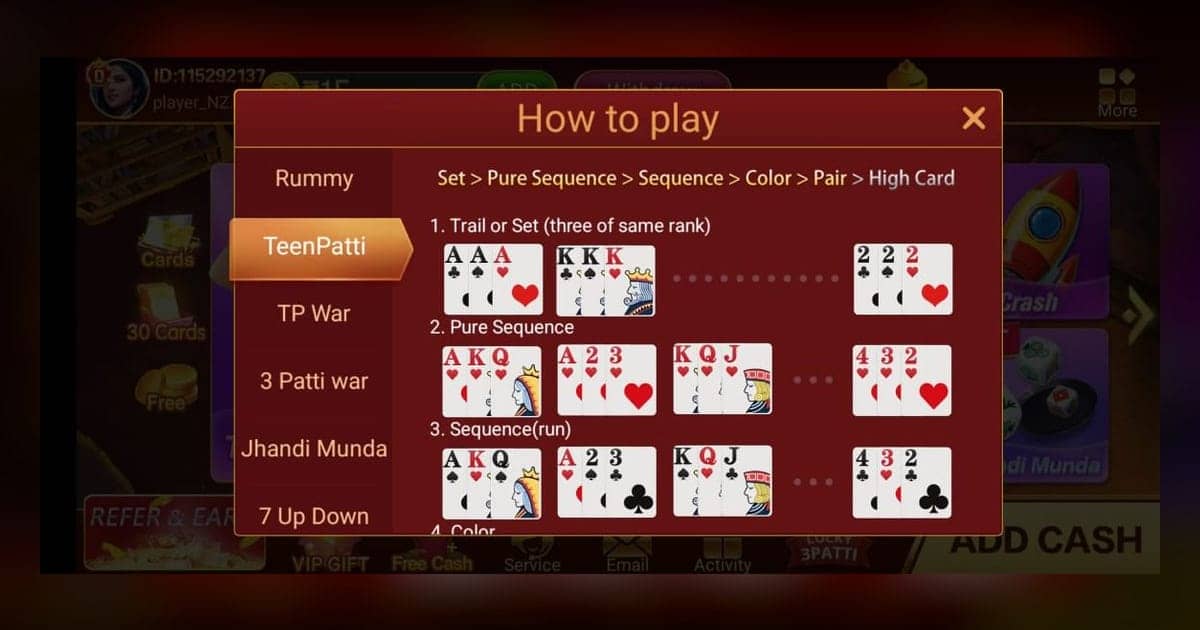
| Rank | Hand | What it is | Example |
|---|---|---|---|
| 1 | Trail (Trio / Set) | Three cards of the same rank | A♠ A♥ A♦ |
| 2 | Pure Sequence (Straight Flush) | Three consecutive cards of the same suit | 7♥ 8♥ 9♥ |
| 3 | Sequence (Run / Straight) | Three consecutive cards, mixed suits | 4♣ 5♦ 6♠ |
| 4 | Color (Flush) | Three cards of the same suit, not in sequence | 2♦ 9♦ K♦ |
| 5 | Pair | Two cards of the same rank | Q♠ Q♣ 5♥ |
| 6 | High Card | None of the above. The highest card decides | A♣ J♦ 8♠ |
Tie-breaks and special cases
- Highest sequence: A-K-Q is the top sequence. In most rule sets A-2-3 is the second highest, above K-Q-J.
- Two trails: the higher rank wins, so three Aces beat three Kings.
- Two pairs: the higher pair wins. If the pairs match, the third card (the kicker) decides.
- Two colors or two high cards: compare the highest card first, then the second, then the third.
- Suits never break ties. If both hands are identical in rank, the pot is split or the player who asked for the show loses, depending on the table's rules.
Probability of each hand
Knowing how rare each hand is helps you decide when to keep betting.
| Hand | Number of combinations | Chance per deal |
|---|---|---|
| Trail | 52 | 0.24% |
| Pure Sequence | 48 | 0.22% |
| Sequence | 720 | 3.26% |
| Color | 1,096 | 4.96% |
| Pair | 3,744 | 16.94% |
| High Card | 16,440 | 74.39% |
Three out of four deals give you only a high card. That is why patience and well-timed folds matter more than chasing big hands.
A sample round
Four players each pay a boot of 10 chips, so the pot is 40.
- Player A plays blind and bets 10.
- Player B looks at a pair of 7s and plays seen. A seen bet has to be at least double the blind stake, so B bets 20.
- Player C looks at a weak high card and packs.
- Player D stays blind and bets 10.
- Player A looks and finds a Color. A is now seen, so A bets 20.
- Player B asks A for a side show. A accepts. The Color beats the pair, so B packs.
- Only A and D are left. D asks for a show, the cards are turned over, and A's Color wins the pot.
Popular Teen Patti variations
- Joker / Wild Card: one card rank is picked as wild and can stand in for any card.
- Muflis (Lowball): the rankings are reversed, so the lowest hand wins.
- AK47: every Ace, King, 4 and 7 is wild.
- Hukam: the suit of a face-up card becomes the trump suit for the round.
- Best of four: you get four cards and play your best three.
Check the table name before you sit down. The variation changes which hands are strong.
Next steps
Once you know the rules, the best way to improve is to play practice rounds and watch how other players bet. Our Teen Patti strategy tips cover when to play blind, when to fold and how to read betting patterns. If you prefer Hindi, read तीन पत्ती के नियम.
Frequently asked questions
What is the highest hand in Teen Patti?
A Trail of three Aces is the best possible hand. Any Trail beats every other hand type.
Is A-2-3 a sequence in Teen Patti?
Yes. In most rule sets A-2-3 counts as the second-highest sequence, below A-K-Q and above K-Q-J. Some private tables rank it lowest, so check the table rules.
What does chaal mean in Teen Patti?
Chaal is a bet made by a seen player, someone who has looked at their cards. A chaal must be at least double the current blind stake.
Can a blind player ask for a side show?
No. Only a seen player can ask for a side show, and only from the seen player who bet just before them.
How many players can play Teen Patti?
Three to six players is ideal. Most apps seat up to five players at one table.